Cordillera Mountains
Good Morning, MidnightThe Cordillera Mountains form the stark, shifting horizon around the Arctic observatory where Augustine Lofthouse stays after the other researchers have been evacuated. Their steep slopes, distant peaks, and relation to the tundra define the small world of the outpost: a place of extraordinary natural scale, but few routes outward. As the seasons turn from polar darkness toward returning daylight, the mountains also measure time, framing the brief sun and the long isolation in which Augustine and Iris live.
Setting and relation to the observatory
The observatory stands on a mountain slope, with a path descending from its concrete steps to a cluster of outbuildings tucked against the incline. The site was selected for clear weather, the thin polar atmosphere, and the elevation of the Cordillera Mountains. Around the central observatory, the outpost’s dormitories, storage units, and recreation buildings are comparatively makeshift; the telescope and the structure that houses it are the base’s most permanent features. The settlement’s arrangement makes the observatory both a workplace and the centre of daily life.
The outpost was provisioned for a dozen researchers to remain for nine months, with fuel, food, purified water, medical supplies, and equipment. Augustine had already stayed almost two years before the evacuation and remained there for nearly three years by the time the returning sun appeared. After the other civilian researchers were flown away, the mountain site became more than a remote research station: it was the setting of a two-person existence, with Augustine and Iris sharing the heated upper floor and the surrounding landscape beyond the observatory’s doors.
Peaks, tundra, and seasonal light
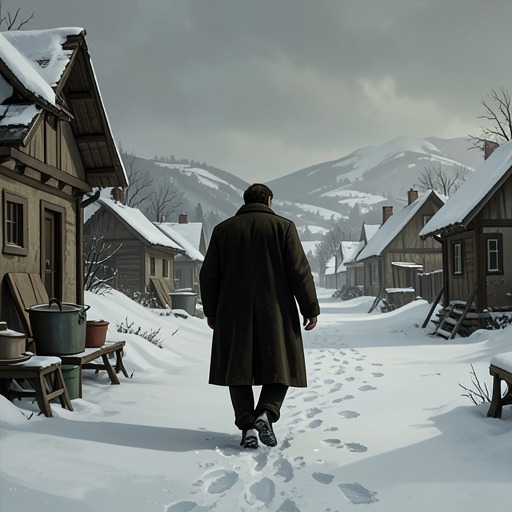
The terrain opens out sharply beyond the buildings. Snow-covered peaks extend toward the northern horizon, while the low, smooth tundra stretches south. From the observatory, the mountains are not a distant decorative backdrop: their jagged outline cuts across the sun, and their slopes govern the routes Augustine takes on foot. The landscape’s scale makes the human structures seem provisional, while the empty spaces between them and the horizon emphasize how few alternatives he has to the place.
Light changes the meaning of the same view. In late March, shortly after polar night has passed, the sun remains low, appearing through cloud near noon and seeming to sink almost as soon as it has risen. On one early spring day, the daylight lasts only about ten minutes. Over the following weeks, light returns gradually, first for a few hours at a time; eventually the midnight sun will rise and stars will fade. Augustine understands the recurring progression from bright summer to autumn twilight and winter darkness, but in the first returning light he finds the low sun especially comforting. The mountains make that seasonal cycle visible, holding the sun at their outline while the tundra receives its fading glow.
Augustine and Iris in the mountain landscape
Augustine experiences the country around the Cordillera as both relief and confinement. In better moments, its blank expanses calm him; in worse ones, their indifference leaves him contemplating madness. He has a history of moving on whenever an environment rejects him, following observatories and advanced instruments from one remote place to another. Here, however, there is nowhere else to go. The mountains and the tundra place his old habit of departure against the reality of being stranded.
After the evacuation, he searches the observatory for Iris, who can be so still that he sometimes detects her only by a blink or the sound of her breathing. From a dirty window she looks toward the Cordillera; inside, she hides among the sleeping bags, sits in a wheeled chair, or examines a broken DVD player with a screwdriver. The mountains remain present even when neither character is outdoors, visible through the observatory’s panes as the boundary of their shared world. As daylight lengthens, Iris begins to accompany Augustine on his walks, running ahead or falling behind. He keeps the green pompom of her hat in sight, and her increased energy and speech make her presence less elusive to him.
Wildlife and the distant encounter
The mountains also provide the setting for Augustine’s recurring awareness of the polar bear. On the day the sun returns, he watches a bear cross a ridge toward the sea to hunt. He imagines the animal’s physical strength and uncomplicated needs, envying a life organized around hunger and sleep rather than reflection. That imagined simplicity briefly offers an alternative to his own burden of thought, though it does not remove his loneliness.
Later, on a walk north with Iris, Augustine sees what he believes is the same bear standing on a peak. He recognizes it less by visible features than by his own quickened heartbeat. Although they are separated by miles of snow, rock, and wind, he feels a kinship with it: he admires its size and apparent purpose, yet also senses its isolation. Iris, sliding down a small slope nearby, does not notice the encounter. The mountains make this meeting possible as a long-distance exchange of attention, rather than a direct approach; Augustine’s response reveals how readily he reads his own solitude into the animal’s distant figure.
Isolation, communication, and narrative significance
The mountain setting gives physical form to Augustine’s separation, but the story also makes that separation audible through the failure of communication. After the evacuation, he tries the available radio frequencies, including amateur and emergency channels, and finds only static. The observatory’s satellite and broadband connections are unavailable, leaving a backup ham-radio system with weak power and limited sensitivity. Augustine repairs and fine-tunes the equipment, then calls out from the control room, seeking any response. The attempt gives his isolation a practical counterpoint: even in a landscape that offers no easy way out, he can still try to send a signal beyond it.
The Cordillera therefore functions as more than a remote landmark. Its clear seasonal changes contrast with the uncertainty of the outside world, while its vastness makes the observatory’s fragile human routines visible. The peaks frame the return of the sun, the movements of the bear, and the small paths Augustine and Iris take together. They do not explain the communication blackout, but they sharpen its felt consequence: the world around the observatory is immense, and the possibility of another human voice remains uncertain. By placing radio calls, solitary walks, and moments of companionship within this same terrain, the narrative makes the mountains a measure of both separation and the persistent effort to connect.